Showing posts with label Andreia. Show all posts

Monday, November 15, 2021

2 transforming years in the field


    Working with Wefoco GBV Ambassadors 2021

It was September 2019 when I first stepped in Africa, in Kenya and in Shianda. We are now in November 2021 and here I am, preparing to leave. At first, I thought I would stay just for 6 months, but as always I allowed myself to flow with what makes me feel good, and I ended up working in Shianda with Wefoco for almost 2 years.

I can’t compare the Andreia of before to the Andreia of now, so much growth as happened in these last years that it would be impossible to put it all in a blog post. 

About the work there were a lot of doubts and fears in the beginning, and it is ok, because it means there was a sense of respect and responsibility towards the project. And this brings commitment. The fear is now gone, the doubts are a constant. 

Questioning ourselves if what we are doing is the best way or not, should we do it differently or not, is a constant in a volunteer deployment time. For me, it was essential to research, read, understand how development organizations work and take some best practices to apply in our context in Shianda. With those tools in hand and a lot of flexibility, I worked with Wefoco projects, allowing the local team to adapt the approaches to what makes more sense to them and supporting on their plan implementation.  

I can say that in 2018 I knew nothing about development work, but now I feel totally different. I didn’t take a course or a master, but I learned by experience. And what an experience!!! being in the field challenged me physically, psychologically, philosophically, emotionally, spiritually and in so many dimensions of my BEing. I am a person that adapts very quickly to different contexts, but that doesn’t mean I can’t be aware of the gifts that my time in Kenya brought in my personal development.

Living without running water, electricity (don’t worry now the houses have everything, lol), in a different climate, dusty road, muddy roads, different gastronomy, waiting hours to get a simple procedure in the hospital, or on a matatu ride from Kisumu … these “challenges” I almost even didn’t notice them, it's how it is, and I flowed with it almost naturally.  


                  Shianda and Nakuru, 2019 
                 
But the work in a diverse cultural context, the intention to make the actions not about “my impact or reach” but about “how this community want to develop and how they can do it on their own” definitely had a huge impact on me.


          Working in wefoco GBV library, 2021

The flexibility to not push things in to what I think is best, the patience to allow a team to reach their decision even if it takes them 30 min or 1h of discussion… the understanding that things always get done in the end of the day even if its looks like a total mess 2 hours after they were supposed to start…

I feel the biggest growth came from interacting with diverse people at a professional or personal level. Meeting persons from so diverse backgrounds (not only locals but also other volunteers) it was such a blessing. Sharing professional relations with some, sharing friendships with others, sharing just small talk, just observing their way, being neighbors, falling in love, being intimate, detaching… all these allowed me to get a clear understanding of who I am and how that “I am” is in constant development and expansion.

My goodbye to Kenya comes with a deep sense of gratitude to:
  • Mondo for believing in me and all the unconditional support and attention they gave me.
  • To Wefoco for accepting and embracing my straightforwardness and irony, and being great teachers in all this process.
  • And to all Kenyans, Ugandans, Tanzanians, Ethiopians, Estonians, Rwandans, Spanish, French, Belgians for showing me how beautiful is the human diversity. It doesn’t matter where we come from, there is no right or wrong, we are just diverse and there is beauty everywhere.  
With Kristy and Steven (Estonia) and Sophie (Belgium), 2020 

       Locking the dreads in a street of Watamu! 

   Trying to cook Ugandan Casava Pankake with Sisa from Uganda, 2020

With Marion (from France) and Inma (from Spain)

        Christmas with Ugandan Friends, 2019

       With Kenyan friends playing drafts, 2020

                         Kakamega, 2021

 
With this consciousness, I want to continue to expand my being with people from all over the world, learn, share and grow. So I have a feeling I will keep on being a volunteer for a while 😊


                      Kipkaren - Kenya, 2021


Friday, October 29, 2021

There is a new library in Shianda!

Yes, there is, and it is in Wefoco. But this is not a common library!


WEFOCO GBV RESOURCES LIBRARY is a library that offers resources for teachers, community-based organizations, individuals and off course Wefoco staff and GBV Ambassadors.

Access to knowledge is limited in a rural area like Shianda, and despite the great work on awareness-raising on GBV issues done already by the ambassadors, their reach can still be expanded. Added to that, in Kenya, the education system is mainly based on expository teaching methods.

So we decided to respond to some of these issues by creating a library of participatory tools to support local facilitators to conduct sessions on GBV and SRHR.

There are resources targeting work with youth, men and women and persons with disabilities.


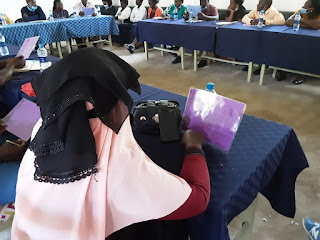
Today we presented the library resources to 25 guiding and counselling teachers from different secondary schools in Mumias east. They tried out some resources and were introduced to the other ones. We had a lot of fun and interesting discussions aroused from the participatory activities.


The WEFOCO GBV RESOURCES LIBRARY will be operating from Wefoco cyber, with resources available for anyone.

The resources were shared with local CBO's, Special Schools and with WEFOCO GBV Ambassadors. The feedback has been positive, so far.

We hope there will be a lot of requisitions and that these tools will support raising awareness in the community about Gender Equality and human rights. 

Andreia Silva
Senior EU AID Volunteer Gender and Education Project in Kenya.  

Monday, October 4, 2021

Disability Inclusion on GBV Programing

When an occupational therapist ends up working in a Gender-Based Violence program...what happens? 

Well has I shared in previous posts 
since this was not my expertise area, I read a lot about GBV, informed about community participatory approaches and successful methods to implement with the Ambassadors Project.

But despite not being an OT practitioner for many years, the love and respect for persons with disabilities are always with me, and the need to improve the accessibility of the services I work on, it comes naturally.  

So after the capacity building training for the GBV Ambassadors (GBVA) on gender topics, and noticing that the participants in their community awareness sessions were mainly persons without disabilities (we were able to understand this thanks to the use of the new age and gender-sensitive attendance sheet that I developed at the beginning of the deployment, to support Wefoco to get differentiated data on the reach of their actions), it was definitely time to raise awareness within the ambassadors for the need to make their sessions more inclusive and accessible. 

Training materials for the session. 

GBV can happen to anyone, information should be given to all, and persons with disabilities, especially women and girls,  due to the intersection of gender and disability, are more vulnerable to GBV, due to: 

  • discrimination and stigma; 
  • negative perceptions of society about their capacity;
  • lack of access to information;
  • isolation; 
  • poverty; 
  • environmental barriers and lack of transport.     
Together with Catherine from the Network of Persons with Disabilities of Mumias East, I facilitated a 2-day capacity building training for the ambassadors, covering the following topics: 
  • Personal attitudes towards disabilities.
  • Understanding disability: a rights-based approach
  • Gender, disability and inequality
  • Root causes of GBV against women and girls with disabilities
  • Vulnerabilities of women and girls with disabilities
  • Barriers to access participation and strategies to inclusion
  • Paths for inclusive programs:
    • Respectful language and Accessible Communication
    • Support networks for persons with disabilities.
    • Planning inclusive actions
Catherine facilitating a training session. 


The training was filled with participatory activities and the ambassadors were very engaged. They were able to be more conscious of their own negative attitudes towards persons with disabilities and to feel somehow in the skin of someone that has a lifelong history of discrimination, subordination and disempowerment. A lot of moments during the training made the ambassadors get emotional when realizing the amount of barriers persons with disabilities might face in society.  The ambassadors also understood that not only the person with a disability might be more vulnerable to violence but also the caretaker or spouse. 


Participatory activities during the training: how to adapt sessions to persons with different needs and reflection on who has more opportunities/power and who has less. 

After understanding the factors leading to increased vulnerability to violence, we reflected on what we can do as ambassadors to reduce that vulnerability in our communities. So we defined what we need to do to make sure persons with disabilities are invited for our awareness sessions, how we can adapt our venues so that they can more easily participate. How can we communicate in a manner that is more accessible for all and respectfully when addressing persons with different disabilities. 

Andreia facilitating the recap on how to plan inclusive sessions. 

From the ambassadors' feedback of the training, the most useful learning was related to the perception and attitudes towards persons with disabilities. “It has helped me change my attitude towards persons with disability... to be positive” “they are all same like other people, should be involved in activities”. In general, they felt that the training increased their knowledge on GBV and Disabilities on a Great and Moderate level. 

Activity on Respectful Language: reflection on how we address persons with disabilities with negative and positive statements in our daily lives. 


The average confidence level of the ambassadors, to work with persons with disabilities and improve the accessibility of their actions after the training was 4 on a scale of 1 to 5 (1 is not confident and 5 very confident). 

Let us hope the results will be shown in the next participants' attendance lists :) 

Monday, September 13, 2021

Meeting Erick and his Lamborghini

It was already getting dark, so I was already inside the matatu (local bus) to go back to Shianda when Erick replied to my message saying "wait for me, I got a bike, and I am on my way to Kakamega"! 

I thought he hired a boda boda (motorbike taxi) to come and meet me in the town centre, so I got out of the matatu and waited. A few minutes after here he was, with his Lamborghini (as he called it):  a bicycle he borrowed from a friend just to come and meet me.  

I had contacted Erick previously asking for his availability for a short interview since he was one of the 52 students that answered the Mondo Child Support Program Follow-up questionnaire I had distributed in the previous months. 

Mondo has been supporting children education in Kenya since 2012 and this year we ran a follow-up assessment to understand how the supported children have been doing after the support finished, their future plans and what was the most significant change the support had in their lives. 

So here I was getting to know Erick story in person!    

In 2015 Erick was struggling to continue his education at a secondary school level. Living only with his grandmother and his 3 younger siblings,  it was difficult to raise income to pay the school fees. One day he came in touch with Wefoco NGO, Mondo partner in Kenya, through the Wefoco Women groups. He applied for Mondo Brilliant Fund, a fund that provides bursaries for secondary education based on students merit.  

“Mondo support was the backbone of my education, without the support I don't think I would have made it” 


The Mondo Brilliant Fund allowed Erick to complete his secondary studies - “It made me be equal to those who are educated” -  in a conducive environment and without stress and concerns on how to find income to pay the school fees “I was full time in class without being sent home for school fees”.  

After finishing secondary he didn't give up on his passion and willingness to continue with his education  “my passion was always to be a biology lab researcher”

It wasn't easy, but he never gave up. He continued to apply for government bursaries and started looking for small jobs to raise some money to pay for his university, "I was carrying carts with water to construction sites to get some money to be able to pay for my studies".

Erick today is an independent young man “I work during the day to pay my rent, my studies and support my siblings... and I study part-time. Currently I am in my second year of Applied Biology and hoping to graduate by the end of next year”. 


When Erick replied to my message he said he was honoured to meet me and talk to me, but at the end of the day, I was the one honoured to meet him in person. He made my volunteer day with his I can make it attitude. His humbleness, strength and resilience were an inspiration to me.


Thanks to Mondo Child Support Program, 186 vulnerable children are currently accessing primary and secondary education in Kenya 2021 school year, including children with disabilities and young mothers.

If you also wish to make a difference and support more children to achieve their dreams, you can join us here: Brilliant Fund | MTÜ Mondo


Andreia Silva

Senior Gender and Education EU AID Volunteer with Mondo in Shianda, Kenya.  


Monday, August 16, 2021

GBVA Mission on a Curfew Night!

 A Significant Change Story by Benjamin Washitakaya     


In July 2020 during COVID pandemic first wave, a daughter of one of my neighbours went out in the morning to pick something from school, this girl remained away from home until very late. At around 8 pm the mother of this girl called me and told me “my daughter is not home and someone told me that she could be in a certain house”. At 8 pm it was already curfew time in Kenya, but I had to do something fast, to support this mother, to find her daughter, and bring her back home safely. Knowing that this mother could not reach that house, and being aware of the need to report this case to the police, I decided to call a taxi (with my wife's financial support) to take me to the police in Shianda with the mother. We reported the case and with the police instructions, we went to the community to reach out to the girl. We found the girl locked in a house with a boy. We brought them back to the police, and the girl explained to the police how she was forced to that house. From that point, the mother and the police were able to handle the case.   
I spent 1000 Shilling that night, but at least I was sure I saved a child from being a victim of GBV
I acted in this way due to the training I’ve received as a GBV Ambassador. Now when I hear about any situation in the community, especially affecting young girls, I act. Before I didn't know how to approach the administration, but now after learning the procedures, I know the system and I can report, I am able to do it myself.    


Benjamin Washitakaya joined Wefoco in 2019 as a member of Khunyiri Youth Women Group, he has been an active member since and is currently the secretary of the group. In the same year, he joined the pioneer group of Wefoco Gender-Based Violence Ambassadors (GBVA). A program developed under the Mondo EUAV SUDHAV2 program to build the capacity of Wefoco groups to prevent and reduce GBV in their communities. Within this program, Benjamin received training on GBV issues and participated in activism actions for the Elimination of Violence Against Women. 
Mondo EUAV SUDHAV3 program is allowing the Wefoco GBVA to carry on their learning on gender issues and supporting them to raise awareness in more communities about women's rights and gender equality. 
If you want to support the activities of the Gender-Based Violence Ambassadors in Kenya visit: Mondo Womens-Fund .


MSC - Most significant change - is a form of participatory monitoring and evaluation that involves the collection of significant change (SC) stories emanating from the field level.  Staff and stakeholders are involved in reading and discussing the collected stories, understanding the value of the changes, and providing further feedback on the project's impact on the field level.  

Stories are being collected by the EUAV from WEFOCO field volunteers' experience (the GBVA), to introduce them into the approach, aiming that they can be more comfortable, later on, collecting stories from the community. 


Wednesday, July 28, 2021

Take action to bring the change you seek!

Social Accountability on Gender Project

To tackle GBV issues in the community is essential to work together, not only with the community but also with the service providers.  


We decided to incorporate a social accountability approach in the gender project activities.

Social accountability or citizen-led accountability refers to how key duty bearers (service providers and policy-makers) can be held accountable for the delivery of quality services to citizens/service users through the engagement of the latter with the service delivery system.

In the gender project, we selected the Community Scorecard Approach (CSC), this approach aims to build the capacities of service users and providers to analyze and monitor service delivery, and to create spaces for constructive engagement to improve basic service provision.

We adapted the approach to the project capacity, so we are applying it on a small scale. In the Wefoco gender project CSC the community is represented by the GBVA. So the GBVA were supported to identify the main issues regarding the local response service systems to GBV and score the local services. 

For the input tracking matrix the Standard Operating Procedures and Guidelines (2019) on GBV for each service were shared and displayed and the roles of each stakeholder according to the National Policy on Prevention and Response to Gender-Based Violence (2014). 

For the community scorecard, the GBVA were divided into men and women; each sub-group engaged in a conversation about the issues they face accessing GBV services, and what constitutes a quality service.

The sub-group discussions reveal themes that are then translated into a series of qualitative indicators (e.g. attitudes of service providers, free service delivery, knowledge of service providers,  confidentiality, etc.) against which each sub-group will score based on their experiences and perceptions of the service. Community members use the following five-level qualitative scale to score each indicator: Very bad, Bad, OK (average), Good, Very good.  Adding remarks to justify their choice.


Once each sub-group has scored their indicators, they come together as one large group. The average score across subgroups is reported in the overall community scorecard. 

The same process was done with the representatives from the response services to GBV, Wefoco invited the Police, Health, Gender, Social Services, Child Protection and Education Offices. From these services, all were present except the child protection and gender office. Together they discussed the main issues the services face and scored the service's response using the same method.   


Later the community representatives (GBVA) presented and the services presented each of their scorecards in a joint meeting. The main issues presented in the booth scorecards were gathered, and a joint action plan was elaborated to address these issues in the next 3 months.  


Some examples of actions included in the action plan were:  advocacy on CBOs forum meetings, training of police staff, chiefs/assistant chiefs, community, social service volunteers, persons with disabilities and school counsellors. 

We are already in the field working to implement the plan. We will keep you posted! :)


Want to know how you can support the activities of the Gender-Based Violence Ambassadors in Kenya visit: Mondo Womens-Fund .

. Andreia Silva, Senior Gender and Education EU AID Volunteer with Mondo in Kenya


Tuesday, June 29, 2021

First meetings with the Gender-Based Violence Ambassadors (GBVA)

Wefoco Gender-Based Violence Ambassadors project started in 2019 with Mondo EUAV Inma (you can check on her blog posts here, the beginning of the project). 

According to a study submitted to Kenya Health Information System by the Health facility data, Kakamega County is one of the leading counties in Gender-Based Violence (GBV) cases with Matungu, Lugari and Ikolomani recording high GBV cases. The COVID19 pandemic led to an increase in vulnerability within the families, due to lack of income generation activities, leading to a rise in cases of domestic violence. The long closing period of schools led to an increase in teenage pregnancies and sexual violence cases.  

It was a priority for WEFOCO to give continuity to this GBV project and continue empowering the communities to fight against violence. 

So here I am, and my first step would be to meet these amazing men and women! 


We had two meetings so far, the first we got to know each other. I listen to them on the work they have been doing, their success stories and their challenges in the field. From these first meeting, it was raised a need for re-cap training on GBV. So we organised a joint meeting with CCABO (a local community-based organization that focus on capacity building on gender issues). CCABO trained the ambassadors in 2019 and so we decided to follow up on their knowledge on gender issues and assess further training needs.     


The meeting was very productive, we re-cap on the concept of GBV, types and most common forms at the household level, community and state level.  CCABO listened to the ambassadors' experiences in the field and challenges and shared also their experience as a CBO (Community based Organization) with Legal Support services for GBV. 

Some of the main challenges the GBVA expressed: 

  • Evidence Gathering (lack of skills and resources - smartphone for photos). 
  • Protection: they have been threatened by other community members since they started to be more active advocates for GBV. 
  • Consent: lack of information on consent/ forms for referral/report cases. 
  • Lack of knowledge on Political Violence issues. 
  • Lack of support on legal matters - Lack of Networking and Referral Skills 
  • Absence of report keeping routine - lack of resources (notebooks). 
  • Absence of visibility/identification uniforms - T-shirts/Bags 
The Ambassadors received record-keeping books to record their actions in the community and we are organizing a series of training on record keeping and on the topics they are facing more challenges (the areas in bolt).


Based on the stories they shared and their experiences in the field, we are collecting Most Significant Change Stories, to access the impact of the project in the ambassadors' life and their communities.  

Thursday, June 3, 2021

“Disempowering oneself is a key means to empower others”

After 2 months break in Portugal, I am now back in Shianda ready to start a new adventure with a new project! This time I will be supporting WEFOCO on their gender and education programs.


Today I am preparing a small presentation for the local organization on participatory approaches. It is amazing to see the amount of knowledge that I have gained in the past months within these deployments. I’ve been searching online on evidence-based approaches to work in the development field and I found really interesting materials that allow me to feel more confident in the work I develop as a volunteer.

As I read into one of the approaches: the Citizen-Lead Approach (CLA) I find this sentence that I choose to title this post: “Disempowering oneself is a key means to empower others”. When I first jump into the possibility of working in the Gender field, I was nervous because of my lack of experience in this area.

But the truth is when we are motivated and willing to learn, the learning process happens naturally. And this is the attitude I want to bring to this project “Disempowering myself to empower others”, I am no expert in Kenyan culture or on gender issues... but I am someone that wants to build together with these women and men a safer, free and more equitable society for all.


This is the attitude I want to keep throughout the project, working together for the same goal, involving the local community from the beginning and allowing them to build this project according to their needs and in mutual agreement. Finding answers for the questions that may arise and solution for the challenges within the local community structures.


I can’t tell what is going to happen, because the plan will be built up within this process. But I am sure we will have a lot of fun! And that I will learn a lot!


Excited to see how the project will unfold in the next months...


as we always say in Shianda “Let’s See...!”


Tuesday, April 13, 2021

Goodbye Party in Kenyan Style!

The last weeks before closing a project can be stressful, there are always so many things you want to do... people to see, finish documents, fill in documents, say goodbyes, close all financial reports, evaluations...etc. 

Knowing myself, I know I'm not good at keeping things for the last minute, so in general, I stress 2 weeks in advance (like it was the last minute, lol) so that in the last week I can have time for any eventuality. 

The last week of the project was saved in my calendar to have final meetings with the organizations I have been working with: Precious Virginia Home, Rise and Shine Special School, EARC and of course Wefoco. 

We discussed the work we did together and followed up implementation of actions learned in the training and in the action plans. 


(Feedback from training participants on their knowledge level to support children with disabilities, before the training, now and future needs) 


(Plan of action to improve services and meet further learning needs). 


A sample of a Facilitator Manual to provide training on How to Support Children with Cerebral Palsy and Profound Multiple Learning Disabilities together with supporting resources (handouts, posters in English and Swahili) was delivered to each Institution. This resource will allow these organizations to continue to facilitate training at a local level by to staff members, parents/caretakers of children with disabilities or other community members. 


Certificates were also delivered to all the participants in the training sessions from parents, cooks, caretakers, gatekeepers to teachers, directors and therapists. 

But there is no goodbye without a proper party. To my surprise, when I reach Precious Home, ready to have our final meeting, all the staff, some parents, the director and even the local carpenter we involved in the workshops for assistive devices, were there waiting for me with cake, soda and lunch. 


During the meeting parents, caretakers and the director expressed how they are implementing what was learned and the impact of having the EUAV working closely with them. The feedback was very positive: parents shared that now they know better how to position their children and how important it is to keep a good positioning, and caretakers shared how they are using the learned strategies to improve the communication with the children on a daily basis. Even the local carpenter shared that he had never done this kind of products before (adapter chair, standing frame, roll...) and now he feels more confident in the making of these devices and its a new skill that was added to his previous ones. 

After delivering the certificates, a beautiful “Farwell Andreia” cake was waiting for me! there were singing and dancing and has the social rule demands the guest (me) cuts the cake and gives a piece to each person. 

After the cake the party was not over yet, there was a photo session, where we joined everyone together with the supplies created in the workshops and the therapy supplies donated to support the therapist work. A lot of photos, a lot of smiles and a great celebration vibe was in the air. 


There was not enough time to cook the chicken for the lunch, so tradition demands we need to take it home. Since the chicken was a male it was gifted to the male member present in the day: Diego - videomaker from Mondo that was following my day has a volunteer in Shianda. Quite handy for me since I don't eat meat! :) 


With a feeling of gratitude, I said goodbye to this amazing team. 

Knowing that even at a distance we will keep in touch! 


Saturday, February 6, 2021

One year in the field!

It was in September 2019 that I came for the first time to Africa, to Kenya, and to Shianda. A lot of excitement, some expectations, and some fears. We are now in February 2021, time flies and I still have difficulties realizing that I have been more than one year in the field (between coming and going). 

The first months in Shianda were full of exploration, getting to know the people, the system, the organizations, the services. At first, I felt I was not doing much, or that my focus was spreading in so many different directions that my impact would not be much. 

Now I understand that these months were essential to allow me to work better after. All the different meetings allowed me to understand better where to focus my energy and to know better the local context regarding the support of children with disabilities. 

With that knowledge, we were able to implement a better assessment and referral system in WEFOCO for the school program children with special needs.
Being all this time in the field allowed me also to see this system being implemented and children getting appropriate support in their education. Sometimes small changes make big differences. 

Now after one year, despite feeling that there is still a lot of possibilities for further work in Shianda regarding the support of children with disabilities, I feel happy with what we achieved. 
All the training, all the meetings, all the knowledge shared and learned, were worthy. 

(Chairladys meeting - follow up on school program children) 

(transporting the supplies for the children in the school program)

With 6 months of deployments, it might be challenging to see effective changes happening in the community. When I came at first I felt immediately that 6 months were not enough, and well was lucky enough to have the possibility to stay longer. 

I remember finding a Special School that was struggling for the past years with administration and management issues and lack of motivation of teachers, I lived that with them last year. But I've also lived with them this year the power of a few motivated teachers, that accomplished the dream of implementing a Special Needs Class in the school. To be that person that the headteacher shared this amazing news in first hand, it feels somehow that I was already part of the school. 
After one year this was an amazing result, not of my deployment but of a mutual joint effort of the education office, the current school staff and Wefoco. With the support from the microfinance of EUAV we were able to appreciate and boost this class even more with some essential supplies to stimulate these children. 


(Special Needs Class in Rise and Shine)

(Rise and Shine children)

(Checking on the finishing of a walking bar to be donated to the Special needs class) 

(Training of teachers, parents and caretaker from Rise and Shine School)


But Rise and Shine special School was not the only place where the positive growth was visible. Last month my mentor Martin a local Senior OT message me "Andreia congratulations on your work in Precious Home, they saw the added value of having a therapist in the home and just hired an OT"  I was ecstatic with this great news, my training is still going on in Precious Home, and the caretakers and parents still motivated to learn. But having an OT in the home will allow the sustainability of the actions and give a better quality of life to all the children living in.  

(Training of caretakers and parents in Precious Home)

(Workshop on positioning aids in Precious Home)

(Workshop on positioning aids in Precious Home)

(Caretakers playing with the children in Precious Home with donated supplies)

(Results of the positioning workshop)

(With Tina - Precious Home director) 

Yesterday while walking in Shianda, one teacher approached me..."Madam...you remember me? from....School" and I was not remembering her well until she sings "Hapana Jiggers... Hapana Cucus"... our song to teach children how to prevent Jiggers! We did a campaign in her school in 2019 and she was still remembering the song after all this time. It made me smile! also to know the jigger situation in school is controlled.  

(Teaching the Hapana Jiggers song/dance to the children)


All these and so many other little stories made me realize that sometimes we might doubt the impact of our actions, but in reality, the is an impact even if not visible immediately or so externally, it is there. 

In the end, we are beings that are an accumulation of experiences, so what I am today is what my experiences, learning process, life, allowed me to be today. The same applies to the communities where we work, that training, that day, that conversation in the street, those sharing about my country or culture, all are part now of other lives and beings. I can only appreciate EUAV and Mondo for the opportunity to be the being I am today, shaped by all these experiences. 

Asante Sana!