Showing posts with label Hanna-Marta. Show all posts

Monday, April 26, 2021

Story from the field


Good times will conquer the bad times!


NGO Mondo has been doing capacity building and income generating activities in rural town Shianda, in Kenya since 2010. Their partner, Western Focus Community Organization (WEFOCO), has been registered since 2009, since Janika Tamm from Mondo was one of the mentor for Esther Mumia, to start WEFOCO. And they’ve been colleagues since.

WEFOCO is an umbrella organization for the community groups around Shianda, who are mainly doing agriculture activities or having livestock or selling firewood or building bricks etc. These groups have been receiving trainings from the EU AID volunteer program since 2018. 15 volunteers have been doing trainings from poultry keeping to marketing, from nutrition and health to gender inequality. This time one of my assignment was to evaluate how the groups feel about our trainings and what they have learned and what they would like to learn in the future. For this I conducted one-on-one interviews with the chairladies and the chairmen and also focus group interviews with the groups. We came to realize that there has been changes in mindsets for the women to be more aware of their rights. They are more open to talk about issues and they will turn for help to the authorities. Families describe they like how they understand their children better and they spend more time talking and explaining things to them.  Another positive influence is that groups are all wanting to continue to learn, to repeat the trainings and to spread the knowledge with their communities.

Due to the struggles which were caused by COVID-19 pandemic, Shianda was facing many difficulties. One of the immediate impact was a lack of access to HIV treatments (medicine being out of stock) and rise in teenage pregnancies, meaning youths having unprotected sex. Another issue that caused insecurities among the communities was the rise in market prices, which went up straight away when the crisis started and haven’t gone down yet. This was affecting our groups who depend on the market, either by being the customer or selling the products. The ones that sell say that they are not making any profit anymore.

Despite all the struggles our groups remain hopeful and positive for changes to come. With the micro finance program we could give the groups a poultry project which will keep them stable for some time.

One thing that was said by one of the chairladies is “other organizations we have seen come and go, but WEFOCO has stayed and for this we are proud”. They feel that they are part of the community, that they should continue to make an effort to learn and educate others and that even when Mondo is not around, they will keep going! Shianda and its people are welcoming anyone and everyone and will stay in your heart for a long time and for this I want to thank Mondo and WEFOCO!


Tuesday, April 6, 2021

Stop teenage pregnancy

Organizing a campaign 


Organizing a campaign is a hustle, but organizing a campaign during world-wide pandemic... we managed. 

Actually, to be honest, the covid restrictions were just something that we head to deal with at the last minute and that's why it became an issue. Changing location, getting permission, following the rules etc...We tried our best but we had to admit that this had an impact on the event. It is because we didn't get as much publicity as we would've wanted. However, organizing anything during these times is a wonder itself, so we are grateful for it. In addition, we had media coverage, which was a new thing for me. Radio, tv, newspapers. And I remember one of the WEFOCO women group chair ladies being so happy for having friends calling her and telling her she was on tv :) 

But what's it all about? 

During the pandemic the schools in Kenya were closed, which left a lot of teenagers idling. Teens were sent back home from boarding to help around the house and do some small work for the family. A lot of the families were scared and worried and had to push their children to find any kind of jobs. There are many sides to this story. One is teens idling and having unprotected sex. The other is that it's common in rural areas for girls to find boys to be the providers for the family, a lot of them started to look to create their own families. Since it was not sure when the schools will open and anyhow the whole situation was very uncertain for the whole world. Of course, we can't change the social norms with one campaign but we can do our part in contributing towards the change and raise awareness of the situation.

Teenage pregnancies is something that needs to be talked about and addressed, as very often the girls are left raising their children alone and don't have enough financial stability. This causes a lot of distress to the families and mental health issues for the girls. Some families abandon their children when such things happen and also dropping out of school is very common in these situations. We have seen some small changes and some schools letting their students to continue, which raises hope for the change to happen.

Before having the campaign we were reading the news and talking with communities - https://www.reuters.com/article/us-health-coronavirus-teenage-pregnancie-idUSKBN27W11H 

Not because of the campaign but one of our program kid was also pregnant and we can happily say that she has returned to school and is helped to raise the child by her mother.   


The campaign 

We organized the campaign for youths for them to learn about different ways to protect themselves. We were talking about reproductive health and changes in the body and mind. We also included free HIV testing and counseling, which is always an important topic to raise awareness on. We had motivational speakers, show for the youths and a teenage mother to share her experience. Again, one of the WEFOCO women group chair ladies told me that it was the first time she saw something like that happening and heard this kind of stories shared, which was really eye-opening for her. That we are allowed to share and talk about "taboo" with our youths. It was a big deal for her, since she has a lot of orphans and single parents in her group, who she feels responsible for. 

To attract the youths we came up (Andreia to be precise) with the logo "COME INTO THE CIRCLE". It aimed to attract to join the safe circle of smart and educated teens, who know how to protect themselves and support each other and feel free to talk about their health and social norms. In the end, the shared feedback was encouraging and we were happy to see youths around Shianda gathering and enjoying good time. The show was something that I think many of them hadn't seen in a while and it was a great day for them to sing and dance and learn something meanwhile.   


Tuesday, January 26, 2021

 I don't know how many days... 

First time I came to Kenya was in 2019 February. I have since travelled and lived in Uganda but still now back to where it all started- Shianda. And it feels great! Being very selfish of course, but it feels great to see the work you've been doing and to see the people and how they're moving on with their lives. Still, struggles are there, even worse because of the year we all have had but when I'm talking with my women groups, I feel they're empowered. They tell me, they shouldn't just idle around and not do anything. They should always find some things to provide them at least some food etc. It's the mindset, that they're explaining to have changed. And it's in their actions, the ideas and plans they have! It's empowering to me and to them and we know now, that difficult times are ahead but we will keep working. I'm very happy with the Shianda community, small and with a lot of resilience.


Monday, October 14, 2019

256 days on the field


Dear volunteer,

of course every experience is different and every volunteer is someone with his or her own personality. But somehow, my experience shows that there are some qualities, which are familiar to each volunteer. For example, joking, all the volunteers I’ve met like to joke and laugh! What an important quality to have. And of course caring! We do care immensely about our job and the people and the organisations we work with. Even though we are put off sometimes we still try to push on through, showing persistance and strength. Finding reasons and solutions and not losing the motivations is a challenge which is very common in a volunteer life. And we do it!

So, here’s to volunteers! “It is what it is” ;) :)


Tuesday, June 25, 2019

145 days on the field.

It's these moments when the neighbour tells you that she doesn’t like it when it rains at night because then you can’t hear when someone is crying for help. These moments remind you again, that you are living in a rural area of Kenya, where the key word is insecurity. I’ve been safe and I feel safe, sadly, this is not the situation for locals.
Violence - domestic violence, gender based violence are problematic topics here. There is still tabu and stigma around it,  still myths and traditions around it, which makes it a difficult topic to tackle. During the trainings on women empowerment we discuss these topics and the ways to protect oneself. I always encourage reporting to police. Unfortunately, to some women, this is not an option because of the fear of not being helped but instead chased away from home.

I have noticed, how in one county, just a few kilometres apart the opinions, behaviours, beliefs and customs can differ. For example, mothers and fathers teaching their children about adolescence or talking about sexuality and ways to protect themselves can be obvious in one area and unheard of in another. Religion appoints a lot in family values. In schools, absence of sex is promoted. Hence, the problem of early pregnancy. I have heard different opinions regarding to this. Some families of course support their child and the continuation of studies. In these cases, child is normally transferred to another school after giving birth, to make the integration back to school more supportive. Other times, when the father of the child is not supporting the mother, which normally is the case, and the family is too poor to take care of the school fees and the newborn, drop outs happen. Even when the daughters family tries to convince the boys family to help them, they are usually left empty handed and boy claims that there is no proof. 

I get asked for help a lot - asking for money; assistance; building a house; fixing something; a friend, marriage, a ticket to Europe or a sponsor from Europe who could support. I understand, how being in need and how living in such uncertainty makes us desperate. Still, I explain, that this is not how it works and that everyone has to work for their own well-being and try to come out of the situation. At this moment, we are both sad because both of us know that “getting out of this situation” is difficult in this context and sometimes seems impossible. This is why being here and trying to make a difference in mind-sets and empowering communities is so important.


Living in such insecurities - trust; work; help; health; authority; even relationship related can make you hopeless but somehow, everyone carries on. We finish the difficult topics and the next moment we joke about something and laugh and enjoy what the host has cooked. Needless to say - the guests can’t leave with an empty stomach!


Wednesday, May 15, 2019

104 days - I'm not gonna even mention how time flies.

It has been extremely interesting to cook together with the community groups. I must say that either due to communication or language barrier, it hasn’t always gone exactly like I planned. Nevertheless it's still been a good gathering and sharing ideas about food and cooking.


I organise the cooking workshops in a way that everyone contributes with the available food that they have in their garden or land, to which I also contribute something in addition. Most common is oil or meat, since these are the most expensive ingredients. When we have gathered the food, I suggest a new recipe and confirm that it is something they haven’t tried before. Much like everywhere else, the traditional foods and recipes stand strong in every day menu and suggesting new ideas can be very surprising for members. However, the feedback has been polite to the new ways of cooking and mixing foods. We have had mashes, stews, mixed vegetables, salads. Few of the groups even want to try something else in the future and promise to learn the new ways of cooking, all in purpose of balanced diet. Let’s see :)

When talking about sharing information and your knowledge, outsiders are sometimes even more trusted. This goes back to history and current political and cultural situations. For example, one of my tasks is giving health talks in the local health centres. It is something that the nurses organise as well. However, I’m always welcomed and even expected to join them because I have more influence. I talk in English and someone translates to local dialect “The Luo” or "The Luhya". It can happen that I may say one sentence and then wait for it to be translated for a few minutes, because in other language it seems to be a lot longer sentence :)


Schoolboys and market day in Shianda
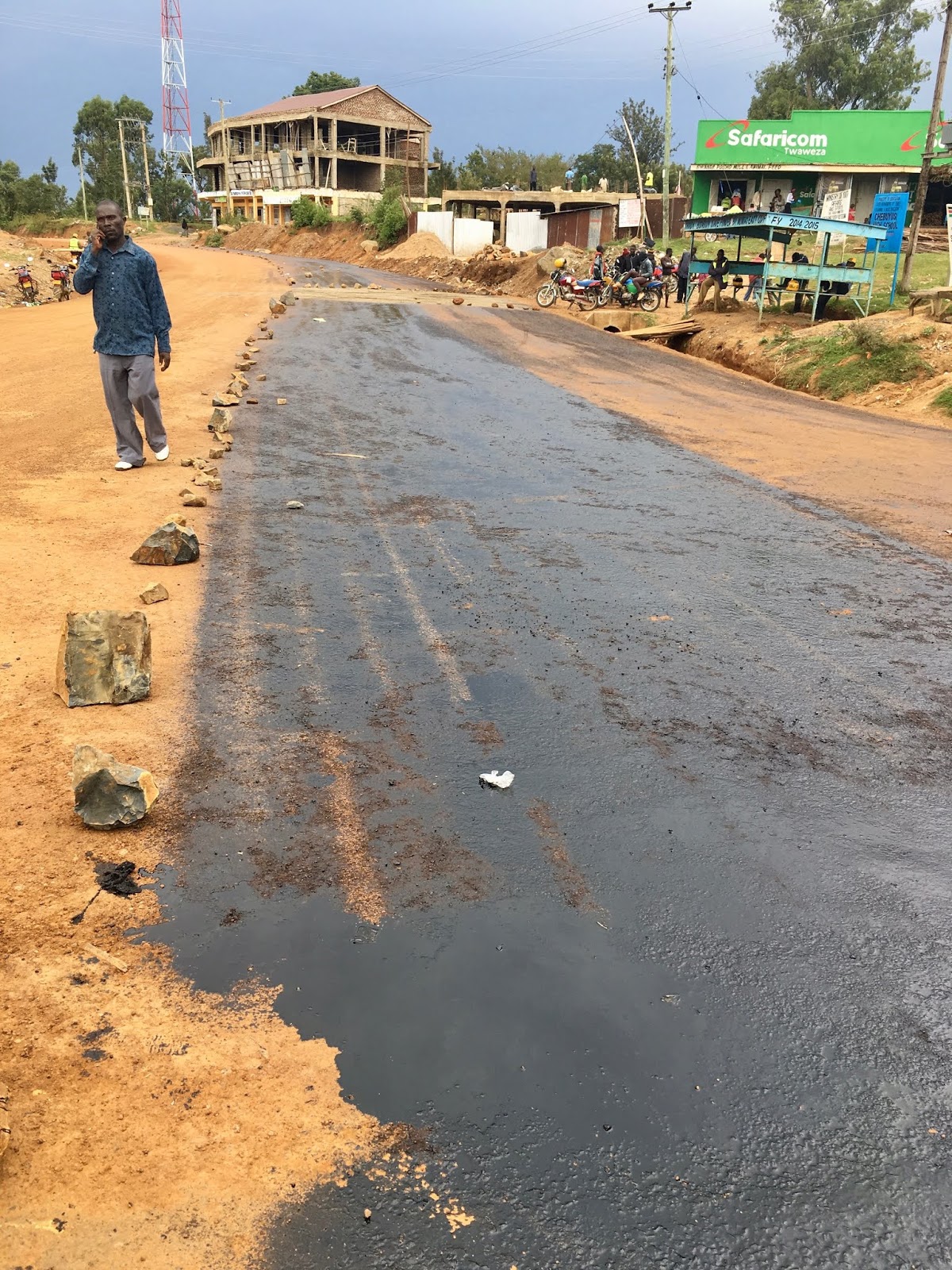
Building a new road in Shianda


It’s true that looking back to previous time now, some things have become more clear and easier to understand. A lot of the confusion with organising comes from the communication. Some days it may seem like “lost in translation” and other days you’re pleasantly surprised how organised a group is or how well someone remembers your agreement.
Communication can be a challenge and avoiding conflicts is very common here. Instead of explaining the situations people use excuses, which leads to cancellation of plans and no-one benefits from that. It is difficult because of a lack of education and a lack of resources, it is understandable. So, one of the challenges is to explain myself more clearly and to build trust being as transparent as possible. I don’t think anyone has ever said that capacity building is easy :) At the same time, there are people who are the most sincere and straight forward with their sayings, which I appreciate and which can also be very funny at times. From now on, one of my favourite words which apparently translates to many different meanings is "Sure".


Saw the snow in Shianda (hail)
After three months, community is used to you, even the local “matatu” (public transport) drivers know where you’re going. I tend to think it’s a good thing, at least here in Shianda. I have had no worries with security. Of course, there is still bribing (though, there are hints that it's changing slowly and government is taking action), stealing from one another (living in extreme poverty) and sadly violence. Considering all this, maybe the biggest danger for me is the road traffic, which is even worse during the nights or in the cities. However, this is the least of my worries now, my worry is that why does the time fly?


PS. I apologise for the blog design.

Wednesday, April 3, 2019

62 days on the field.


Is nothing. Is something.

There are these thoughts constantly going back and forth “I still have time and I'm beginning to understand things now and keep on doing my work” and at the same time “I still haven’t done anything useful and I should understand more and there actually is no time”. This is when you remind yourself again that this is how it was going to be - you cannot do everything and understand everything and you must focus on the things you can do.

So, I’ll share what I’ve been doing. My main focus is working closely with our organisation WEFOCO community groups that are located in Mumias East, around Shianda. They gather at one specific place where they are used to meet (for example the chairlady's place or a local church) and then we have different topics for trainings that we are going to cover with them. I say we, because there are 3 other volunteers working with the same groups. My topic is nutrition and this month I did the basic introduction to nutrition. I talked about hygiene and nutrition values in different foods and importance of nutrients. Also very briefly mentioned the burning of the plastic and the effect it can have on our health and environment, because plastic is burnt with all the trash and the ashes of the plastic get to the soil in which they plant their vegetables and crops. There is no system for managing waste in Shianda or the areas around here yet.


I’m happy to see that a lot of the knowledge is there but the implementation is something to work on. In rural areas, most of them have land and are trying to grow vegetables and something to sell at the market or have at home. Im saying “trying”, because right now it's supposed to be the rainy season. Although, we are still waiting for the rains to start and just as we were discussing in the office the other day, people are getting more and more stressed about it and facing a lot of problems, which will have an impact on the life around here.


The implementation with groups will be cooking together and repeating the importance of having variety in food and letting the groups know that the healthiest food comes from their own land and not the market or supermarket. I have heard many stories how different countries spoil the market here with their imported foods that don’t have healthy nutrition value and are cheaper for the locals to buy.


I went to a school, where I talked about nutrition with students and I could see that they had been taught about it but the truth is that they still get to eat mainly one kind of food every day.


What I see is that there are a lot of health problems in this area which are curable with having the right diet and availability for better hygiene. Of course, better health starts with taking care of the hygiene but having no access to clean water is making it difficult. Wells are drying and there are lines of people with buckets to take water from the river, which will also dry out if it continues for much longer, but life doesn’t stop.

It is true that when you travel around Africa, you see and feel the “hakuna matata” vibe which I really appreciate but when you stay at one place for a longer time you start to notice how a person is struggling and working long hours just to make ends meet. There is a difference in time management and postponing happens a lot, even though I think there is always a reason and its hardly ever “just because”.  With my time I feel like I want to empower all the hard-working, struggling grown ups and children that I meet, which will be the topic for my next trainings to come.

And as our dear landlord likes to say: “ Otherwise, good night!” :)

Btw, while I was doing this post it started raining! So I guess the dance for it worked ;)

Friday, March 8, 2019


Greetings from Shianda and Happy Woman's Day (here we celebrated it on the 10th of February)!