Tuesday, May 24, 2022

SOMETHING WONDERFUL ALWAYS HAPPENS


Bye bye comfort zone

It’s been a little over a month since I arrived here in Shianda and yet, for all the feelings and situations that are going through me, it seems like a lifetime ago. The incredible thing? That, nevertheless, I continue to be amazed with each passing day: by the people, by the gestures, by the colours, by the sounds... by everything that surrounds me. I continue to be amazed by Kenya.

There’s so much I’ve learned. "Learned" is actually an exaggerated term; let’s say I understood that there are some ways of reasoning, outside of mine, that I would like to absorb and put into practice.

I thought of three simple, closely related concepts, which can help me summarize this first part of experience:


1. TIME BRINGS PATIENCE

The way life is approached has nothing to do with the reality I am used to. As well as time, which flows and is used differently.

Waiting for members
From the exact moment you get off the plane you inevitably face one thing: waiting. As I said, time here seems to flow in a completely different way. Most of the time, in Kenya, you wait. People spend a lot of time waiting. Sometimes they wait for something. Other times nothing. But they wait.

And in the meantime, time goes by.

Sometimes my attention gets completely captured by these people. And I think the frenzy is something completely unknown to them. In Kenya you live "pole pole". If you have a meeting scheduled for 10, for sure it won't start before 11.

If I try for a moment to hazard a comparison with my country of origin, a smile escapes me: in Italy, I don’t have time to enter a bar to order "One co.. ffè" that the bartender has already prepared and served it to me.; if, on the other hand, I go to the post office, I see people losing their temper after a minute of waiting.

And in the meantime, time goes by. Without being savoured.
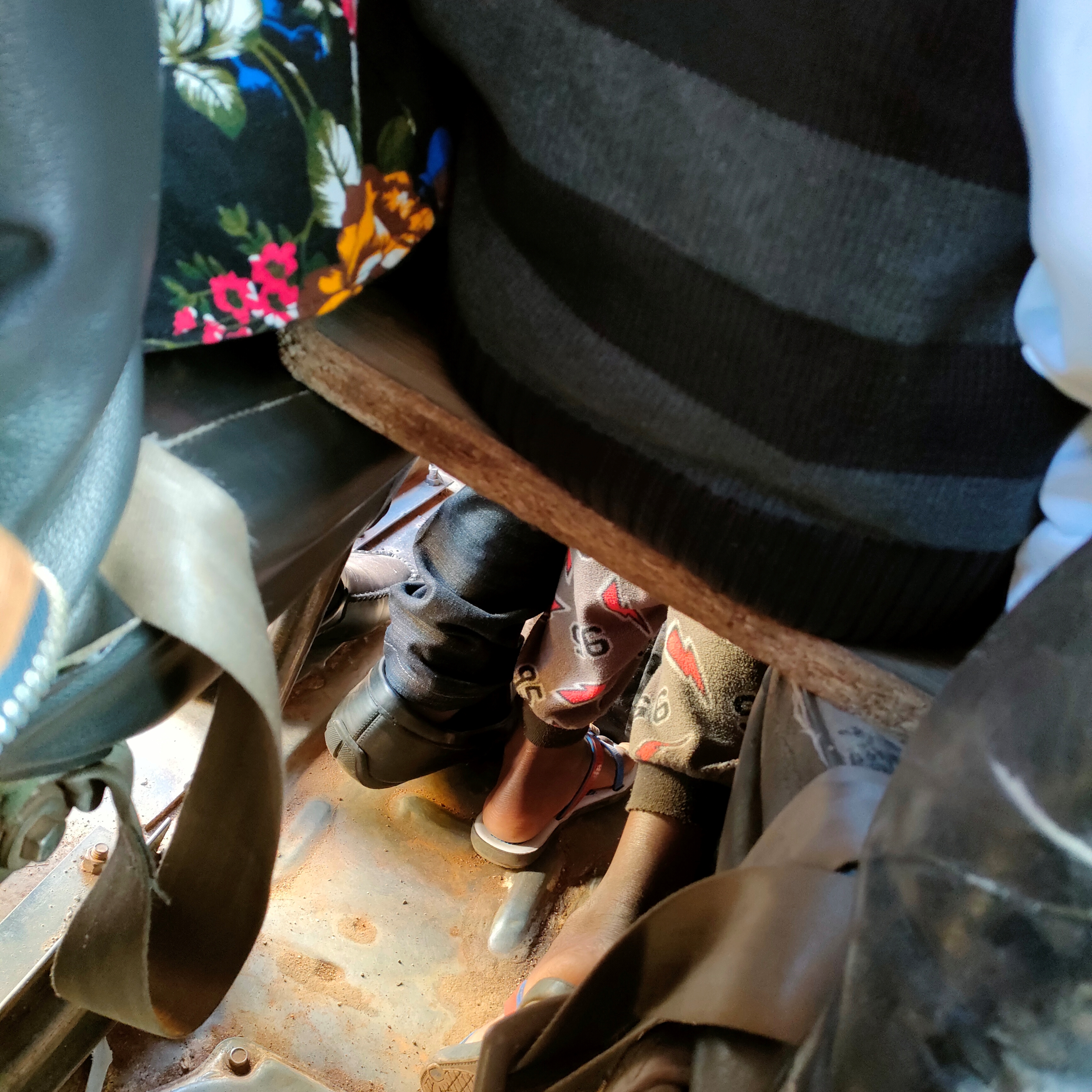


Wooden board seat
2. YOU ALWAYS FIND A LIFT (or a way)

It’ true, the road has always been known as something dangerous. But here it's also incredibly fascinating. (Apart from the fact that it is still difficult for me to define a road as such, since any vehicle is able to circulate in any place. In any case…) Indefinable the number of matatu that cross Shianda every day. As indefinable is the number of people that these matatu can carry. To explain me better, these are small buses approved for 14 people + the driver; but in times of need, these places multiply. As if by magic! And if there are children on board: all in your arms! The next step is the mobile seats that are “created” with a small wooden board, placed between two pre-existing seats. But it doesn't end there, no. Because if the seats on other people's laps and the wooden boards run out, then you travel outside. Yes, that's right. People literally cling to the door and windows and travel outside.


The more we are, the better is
It is something I see every day, but it continues to make me smile every day, to surprise me. Of course, sometimes even questioning me about the safety of these vehicles and the rules of the road, but maybe I’ll deal with this topic over the months. Today I just want to focus on how much more extravagant you can see here. And if you prefer to travel on 2 wheels, you can always look up at one of the many boda, a motorcycle that transports an average of 2 to 5 people. That’s incredible too, isn’t it?

I mean, wherever you have to go, you’ll get there!


3. EVERY PROBLEM IS NOT A PROBLEM

As can be understood in part from the previous lines, in Kenya there is a solution to everything.

Or rather, there is nothing that can be considered a real problem. I want to specify that since my arrival I have not yet had to reckon with the lack of water, will be luck or perhaps due to the rainy season, which allows you to accumulate everything that the sky has to offer in large containers located outside the houses (tank); Instead, it happened to me that I had to cope with a blackout, but since I don't have a fridge, or even a freezer, I'm certainly not afraid that my food will thaw!

Torch to the head and face the evening. And considering that the sun sets early, it gets dark early. In reality, if I think of it in these terms, I have no fear at all. It’s the way you decide to face challenges that makes the difference. I’m choosing to hug Shianda every morning.

Uh..and if to go and visit the people of the village, you find yourself walking with flip-flops in the middle of the storm, do not break down. Maybe you come home with a delicious papaya just picked up and a piece of bed found by chance with which to build the shelf that you so desired.


In short, be patience and enjoy the journey because something wonderful always happens.

The sun in the rain
The light in the dark


Tuesday, May 17, 2022

2nd month in Shianda

My second month in Shianda has gone, and I can finally seem to have understood what my purpose here can be.

It has been quite hard at the beginning because I was not sure about what to do here, or how to be useful. However, I learned that ideas and their development just come naturally. 

I conducted a needs assessment, visiting twelve groups, and asking them about their activities. Once you see that farmers are struggling against the same problems, it becomes easier to find a possible solution. I decided to try to find a way to increase the number of vegetables they cultivate, tackling the two main constraints farmers usually face: lack of water and lack of land. 

What do we do when the space is horizontally limited? We go vertically! Growing crops in sacks will allow planting vegetables like kale, spinach, cabbage, tomato, and onions in a reduced space. Moreover, the bags can contain water better than the soil, which drains easily.


Avocado seedlings dying in a nursery due to lack of water (Khunyri Orphans group)


An example of vertical bag seen from the top

These days I am busy organizing training on this topic for around 40 smallholder farmers. On one hand, I like the idea that this activity may enable them to improve their diets when consuming these vegetables, or their income when selling them. On the other hand, this can also be kind of stressful and scary. 

Monthly meeting with the chair ladies of the community groups
When you find yourself in a place like Shianda, and you start paying visits to the groups, to the local people, in their houses, meeting their families, and you listen to them sharing their life with you, you see you are in the right position to do something to help. Coming from Europe, with all possible economic means but a Western mindset, gives you the impression that you really do not know what you are really doing out of your possibilities, nor what you could do to have an impact on the wellbeing of the local population. It seems hard to detect where people place the border between everyday normal challenges and life struggles. Some things are not seen as a real problem, but just like the normal way of life here.


Use of compost to fertilize the soil
A funny example is how we consider washing clothes by hand as something dated and an avoidable activity, while people here do not trust washing machines. They do not understand how we can rely on some technology incapable of detecting stains as the human eye is.

This is to say that finding solutions to many problems can be very hard due to cultural differences, as there are different ways of seeing and interpreting reality.

Visiting Wichelu group and one of their composting sites


I do not know if I really understood the community, how things work, and what people are expecting me to do for them, but at least I will give it a try with this new idea. My final aim is, of course, to have a real impact on the life of these people, at least on those of some members of each group. 

Wednesday, April 27, 2022

Shianda, Shianda


New products


I have been in Shianda, Kenya for two months as a Mondo and Wefoco volunteer. It is a wet season at the moment In Kenya. Usually it rains in the afternoon and at night. I like the rain because it reminds me a bit my home, Estonia. 

My work experience in the local Tailor Shop 


We started to generate new ideas for new products. The use of plastic bags is prohibited in Kenya, locals are using small synthetic bags which unfortunately are not very durable. They break very fast. 

We decided to start sewing fabric bags, which could be worn on the shoulder and packed small if necessary. For the finishing touch we embroidered our village name on the bags. Unfortunately the quality is not the best yet as our sewing machines, embroidery machine, and overlock machine need some repairs, but we are working on it.


Handicraft teaching groups in Khaunga and Esukura villages

All the groups started from the very beginning, they had no previous experiences with handicrafts. The participants manual skills are very different, some learn new skills fast some don’t. In both groups there are people who come to lessons every week and people who are coming only once to try it out, but soon releasing that handicraft is not so easy. So far we have made a great progress - from learning the original loops of crocheting we have now crocheted a hat. 


Esukura women's grupp


Khaunga women's grupp


I like to explore


On my free time, I like to visit and explore new places in Kenya, such as Kakamega Forest, Lake Victoria, Kisumu City, Maboko Island and more. You can see all the beautiful places on my pictures!


Kakmega Forest

Like Victoria


Dunga fish beach


Tuesday, April 19, 2022

1st month in Shianda: karibu!

My first month out of six in this tiny village in Western Kenya has gone. Time has been passing at very different paces each day, according to my mood of the day.

Looking for a way to make coffee
Certainly I had expectations and ideas about how my life could have been here, but you can never really know until you find yourself experiencing it. On one hand, I adapted easily to the Shianda’s way of life, despite many small and big things Europeans like me are not used to. For what concerns housing, I got used to cook on a gas cylinder in absence of a stove (this is twice more difficult when you are Italian and need to make coffee with your moka), taking showers without any shower cubicle in the bathroom, washing my clothes and linens by hand since washing machines are an unnecessary luxury when electricity and water are subject to interruptions. I believe these interruptions would make any Western person seriously aware of the lucky part of the world they come from: not having access to tap water for days can be a real challenge. This means you have to collect water from “emergency” tanks in your garden and use this to wash your dishes and brush your teeth. If these instances sound extreme to you, be aware that this is actually the most comfortable lifestyle you can dream of in Kenyan countryside villages like Shianda.

Basins for hand washing
While adapting to this all accommodation condition has been surprisingly fast, on the other hand I had a hard time giving up some of my deep-rooted habits. While during the day you can go for a run, some shopping, lunch out, or just a walk without worrying, but even enjoying the sun and some friendly chitchat with the locals, the same cannot be said for the evening. You have to worry for two major things when the sun goes down around 7 p.m.: mosquitos and your own safety when out. Night mosquitos may carry malaria, therefore you get ready in time by closing doors and windows, spraying mosquito repellant and pulling down a net over your bed. This if you are home, as you often happen to be since going around during nighttime is not the wisest idea. This situation was very hard for me to accept. I am used to live in European cities where it is common to go out for dinner or to a club during the night, but such kinds of entertainment do not even exist in these small villages, and even if they did, it would be dangerous. Eventually, you find other ways to spend your time within your safe four walls and go to sleep at 10 p.m.


My writing may sound very miserable, but I find it interesting to share this totally different way of living, with both its difficulties and positive aspects. Of course, in the end, these last exceed the early. Mondo and Wefoco’s (Mondo’s local partner) work here is of great importance to the people of Shianda. Feeling part of the community while contributing to Wefoco’s mission is something of great value. 


Visiting the community groups of women who live in the surroundings of Shianda made me aware of how much they rely on our help to face the many challenges that mark their lives. Many women in this area decide to join together as a group in order to share their finances, land and knowledge to achieve goals they could never reach by themselves. For example, during the last few years these groups have been joining Mondo and Wefoco’s poultry project: they were given an initial number of chickens with the purpose of generating income through the selling of eggs or chicks born from those laid eggs.


I have been visiting some groups to ask them how this and other activities are going and which are the main challenges to them nowadays. They told me they are still practicing chicken farming, selling eggs and/or chicks to pay for children’s stationary or putting this money in a common fund for any emergency a member could face in future. At the same time, they asked for some advice on how to improve their yields. They are increasingly worried about droughts, pests and fertilizers prices. For what concerns the latest issue, they are trying to rely on their manure compost only, but for the other two there is little they can do. Irrigation is possible only in few cases when there is a water source nearby, while finding an affordable and effective pesticide for insects damaging the crops is not always simple.


13th April: visiting Msalaba Women Group 
My aim is to help these women and their groups find a successful and sustainable way to generate income through farming despite all these current problems. Developing consciousness towards the market functioning, to be more competitive, choose the best crops and agricultural practices for specific kind of soil, location, and weather conditions, together with animal farming, can bring to secure revenues and an improvement in the lives of these people.

13th April: visiting Msalaba Women Group 

No matter how life is different here, how some days can be harder than others, what really matters to me is feeling like we can go further by cooperating together, and witness the results of this team work. 


Msalaba Women Group's irrigation system powered by photovoltaic energy 

14th April: Esukura Women Group's poultry cage for the night


Monday, March 28, 2022

Hot greetings from Kenya!

Eve Kislov
Hello, I am Eve Kislov and I have been living and working as an EU Aid Volunteer for NGO Mondo and WEFOCO for a month now. 

My task is to strengthen the independent development of Shianda community in Western Kenya. Simply put, my goal here is to support a local Tailor Shop for six months by developing new products together with the women and men of the Tailor Shop and if possible, to find buyers for these products. 

Although I had previously received extensive training from the European Union, I was seriously amazed in the first few days by the huge crowd, how everyone are running their errands. The people were infinitely friendly and curious.

In a month, I have become part of this bustling community. Since it is a known fact that one picture says more than a thousand words, I have taken many photos which I will add to this blog post as well.

The first working days at the Tailor Shop

Meeting with colleagues in the Tailor Shop, it soon became clear that the seamstresses did not have to fill regular orders, and the sewing machines and furnishings in the Tailor Shop needed to be upgraded.

We consulted and realized that since repairing sewing machines takes time, we try to use the time as efficiently as possible and create some new products by crocheting and knitting.


The plan was not very successful. There are no handicraft classes at schools in Kenya. Primary skills come from grandparents. Another problem is that crochet hooks and needles can only be bought in specialty stores in larger cities, and unfortunately, the choice of materials are very limited. Natural materials such as wool or cotton are not available in Kenya, products can only be made from acrylic yarn.

Despite the difficulties, we started the test work and to my delight, the first crocheted and knitted hats are now completed.


Crocheting and knitting enthusiasts also in other villages

It is a great pleasure for me to visit the various villages near Shianda. Meeting with local people have been uplifting and fulfilled with laughter, local food, singing and dancing.

From one of the invitations to visit Khaunga, I developed a new handicraft workshop. I am starting to teach there once a week. To get there the only option is to ride by motorcycle for half an hour, as there is no regular bus service between the villages. For me this is definitely a new experience (and not my usual transport I'm used to), but it is fun. 


Visiting new places

On my free time, I like to go out and explore new places. In addition to the nearby villages, I have taken a bus to Kakamega and Mumias. There are only local people, no tourists on sight. They all live, work and enjoy their free time, just like me living and working in Africa.


Monday, November 15, 2021

2 transforming years in the field


    Working with Wefoco GBV Ambassadors 2021

It was September 2019 when I first stepped in Africa, in Kenya and in Shianda. We are now in November 2021 and here I am, preparing to leave. At first, I thought I would stay just for 6 months, but as always I allowed myself to flow with what makes me feel good, and I ended up working in Shianda with Wefoco for almost 2 years.

I can’t compare the Andreia of before to the Andreia of now, so much growth as happened in these last years that it would be impossible to put it all in a blog post. 

About the work there were a lot of doubts and fears in the beginning, and it is ok, because it means there was a sense of respect and responsibility towards the project. And this brings commitment. The fear is now gone, the doubts are a constant. 

Questioning ourselves if what we are doing is the best way or not, should we do it differently or not, is a constant in a volunteer deployment time. For me, it was essential to research, read, understand how development organizations work and take some best practices to apply in our context in Shianda. With those tools in hand and a lot of flexibility, I worked with Wefoco projects, allowing the local team to adapt the approaches to what makes more sense to them and supporting on their plan implementation.  

I can say that in 2018 I knew nothing about development work, but now I feel totally different. I didn’t take a course or a master, but I learned by experience. And what an experience!!! being in the field challenged me physically, psychologically, philosophically, emotionally, spiritually and in so many dimensions of my BEing. I am a person that adapts very quickly to different contexts, but that doesn’t mean I can’t be aware of the gifts that my time in Kenya brought in my personal development.

Living without running water, electricity (don’t worry now the houses have everything, lol), in a different climate, dusty road, muddy roads, different gastronomy, waiting hours to get a simple procedure in the hospital, or on a matatu ride from Kisumu … these “challenges” I almost even didn’t notice them, it's how it is, and I flowed with it almost naturally.  


                  Shianda and Nakuru, 2019 
                 
But the work in a diverse cultural context, the intention to make the actions not about “my impact or reach” but about “how this community want to develop and how they can do it on their own” definitely had a huge impact on me.


          Working in wefoco GBV library, 2021

The flexibility to not push things in to what I think is best, the patience to allow a team to reach their decision even if it takes them 30 min or 1h of discussion… the understanding that things always get done in the end of the day even if its looks like a total mess 2 hours after they were supposed to start…

I feel the biggest growth came from interacting with diverse people at a professional or personal level. Meeting persons from so diverse backgrounds (not only locals but also other volunteers) it was such a blessing. Sharing professional relations with some, sharing friendships with others, sharing just small talk, just observing their way, being neighbors, falling in love, being intimate, detaching… all these allowed me to get a clear understanding of who I am and how that “I am” is in constant development and expansion.

My goodbye to Kenya comes with a deep sense of gratitude to:
  • Mondo for believing in me and all the unconditional support and attention they gave me.
  • To Wefoco for accepting and embracing my straightforwardness and irony, and being great teachers in all this process.
  • And to all Kenyans, Ugandans, Tanzanians, Ethiopians, Estonians, Rwandans, Spanish, French, Belgians for showing me how beautiful is the human diversity. It doesn’t matter where we come from, there is no right or wrong, we are just diverse and there is beauty everywhere.  
With Kristy and Steven (Estonia) and Sophie (Belgium), 2020 

       Locking the dreads in a street of Watamu! 

   Trying to cook Ugandan Casava Pankake with Sisa from Uganda, 2020

With Marion (from France) and Inma (from Spain)

        Christmas with Ugandan Friends, 2019

       With Kenyan friends playing drafts, 2020

                         Kakamega, 2021

 
With this consciousness, I want to continue to expand my being with people from all over the world, learn, share and grow. So I have a feeling I will keep on being a volunteer for a while 😊


                      Kipkaren - Kenya, 2021